
This history of the Society was kindly supplied and written by Stuart Eagles, author of After Ruskin: The Social and Political Legacies of a Victorian Prophet, 1870-1920 (Oxford: Oxford University Press, 2011) [last update: September 2022]
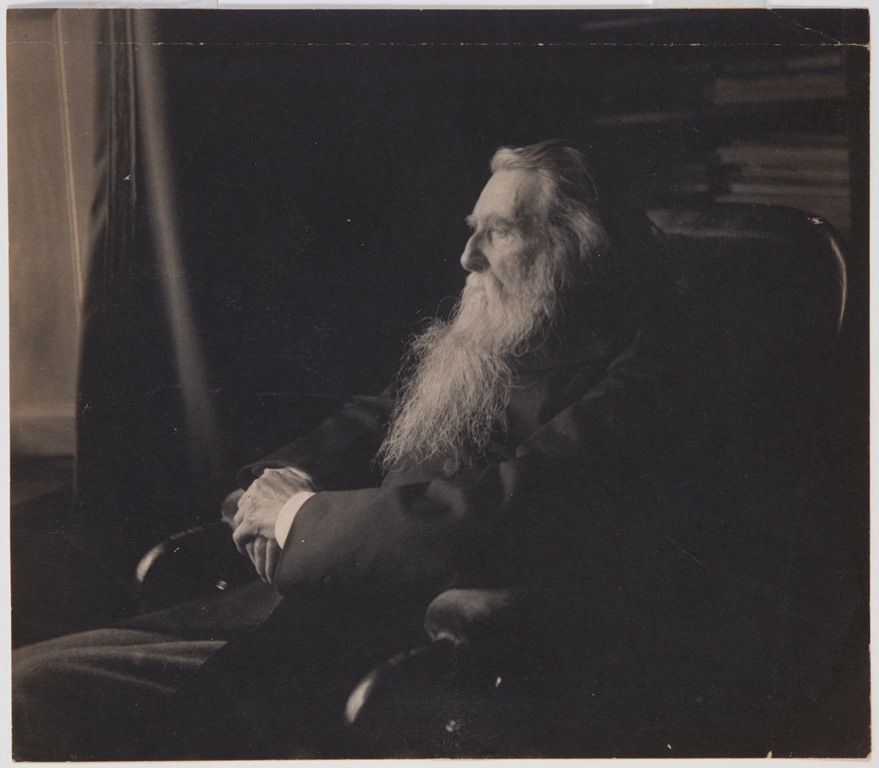
KEY DATES
1878: First Ruskin Society proposed in Manchester
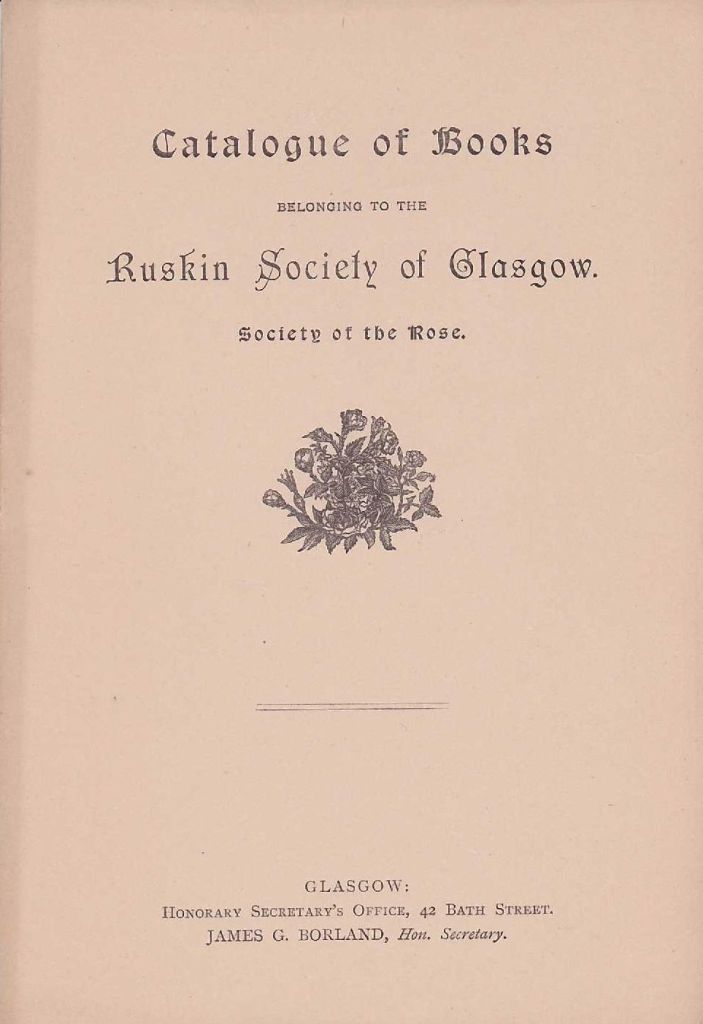
1879: The Ruskin Society (Society of the Rose) founded in Manchester, and branches formed in Glasgow and Aberdeen
1881: More branches formed in London, Birkenhead, and Sheffield
1883: Ruskin Society of Liverpool formed
1896: Ruskin Society in Birmingham formed, and other branches in Paisley and Douglas
1898: Saint George, the journal of the Ruskin Society of Birmingham, launched
1900: The Ruskin Union, a national body, founded
1919: Ruskin Centenary Council co-ordinated a year of commemorative events
1931: The Ruskin Society founded by J. H. Whitehouse
1932: First Ruskin Birthday Dinner held on 8 February at the English-Speaking Union
1985: The Ruskin Society of London founded by Lord Lloyd of Kilgerran
1997: Today’s Ruskin Society founded
The Ruskin Society, in its present form, was founded in 1997 to celebrate the life, work, and legacy of the Victorian critic of art and society, John Ruskin (1819-1900). A particularly important date in the Society’s calendar is 8 February, when Ruskin’s birthday is commemorated with a special lecture, discussion, and a toast to his memory. This continues a tradition that, in one form or another, can be traced back to the first Ruskin Society.
THE SOCIETY OF THE ROSE
The first Ruskin Society, alternatively known as the Society of the Rose at Ruskin’s suggestion, was formally proposed in Manchester in December 1878. It held its first meeting in the city in January of the following year. The Society’s purpose was to promote knowledge and interest in Ruskin’s work and ideas, and to make his writings more widely and readily accessible.
Affiliated but autonomous branches were quickly established elsewhere, including Glasgow and Aberdeen (1879); Sheffield, Birkenhead and London (1881); Liverpool (1883); and Paisley, Douglas (Isle of Man) and Birmingham (1896). They hosted lectures, readings, discussion and study sessions, excursions, campaigns and annual socials, or ‘conversazione’.
Leading figures in the worlds of art, design, architecture, literature, education, religion, and politics were attracted to address meetings. Among them were A. H. Mackmurdo, C. R. Ashbee, Keir Hardie, W. T. Stead, G. K. Chesterton, Thomas Hall Caine, Canon Rawnsley, Henry Scott Holland, Pearl Craigie, Margaret McMillan, Teresa Billington-Creig, Henrietta Barnett, Maude Royden, May Morris, T. C. Horsfall, Charles Rowley, Arthur Sidgwick, G. M. Trevelyan, J. W. Mackail, Oliver Lodge, Henry Newbolt, Patrick Geddes and W. G. Collingwood.
Prominent members of the Society promoted Ruskin’s values in the community. The Society contributed to debates of national significance as well as local interest. In some branches practical schemes were undertaken to improve civic life and ameliorate social conditions. In Glasgow, for example, there was a campaign against sweated labour, and in Liverpool a spinning class for the blind was inaugurated.
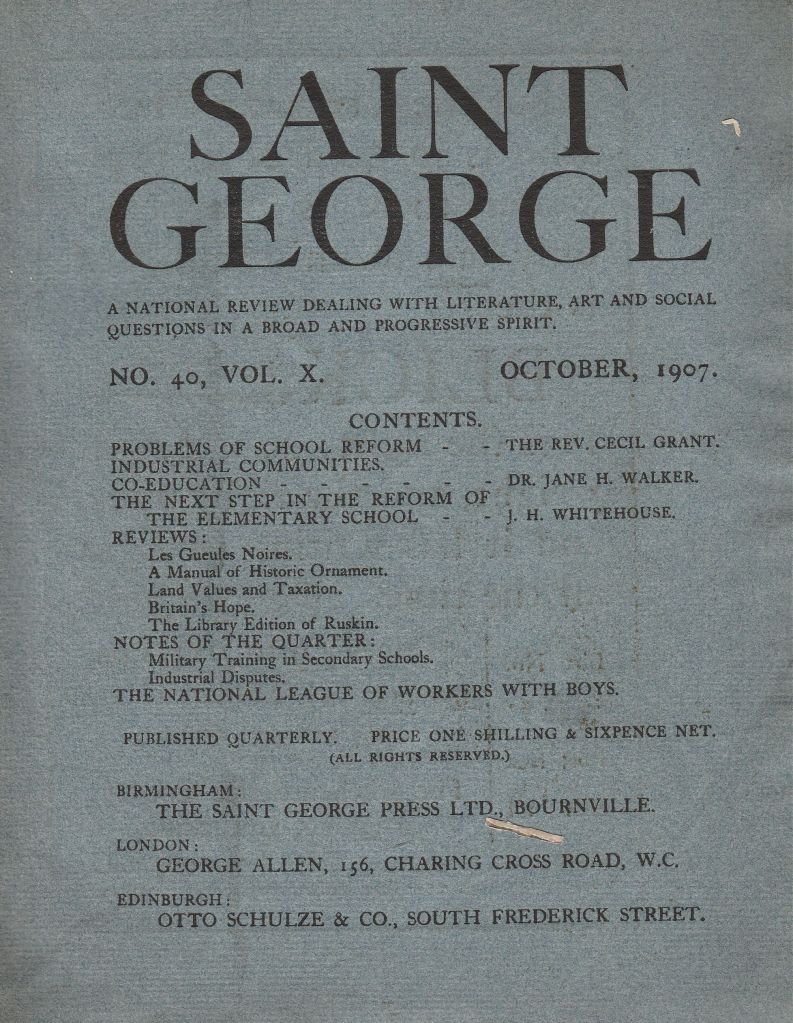
In 1898, the Ruskin Society of Birmingham launched Saint George, a quarterly journal which discussed contemporary issues in a broadly progressive spirit and from a Ruskinian perspective.
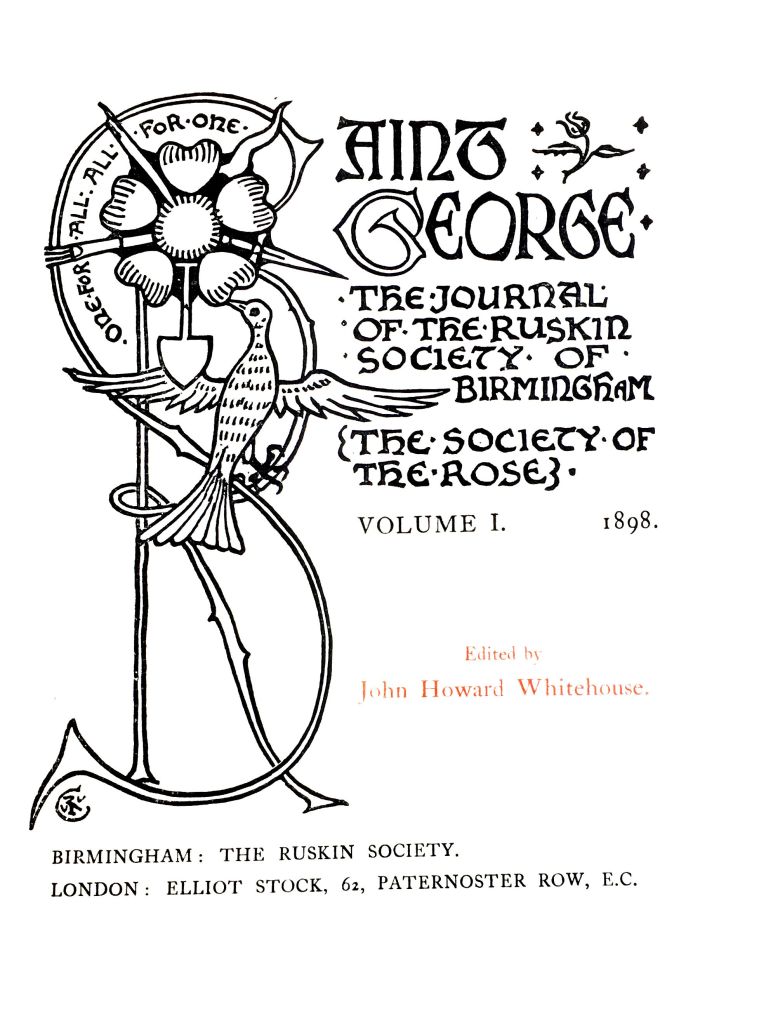
St George boasted contributions from such people as William Beveridge, Canon Barnett, J. H. Badley, Godfrey Blount, Dean Farrar, Jimmy Mallon, T. E. Harvey, and J. Lewis Paton. It was edited by John Howard Whitehouse (1873-1955), later a Liberal MP, an innovative educationist, and the world’s leading Ruskin collector. Over the course of the next 13 years, the journal won a national reputation as an important forum for social, educational, political, and cultural debate.
The Ruskin Society grew in importance as Ruskin himself faded from public view in the late 1880s. Around this time an independent Ruskin Reading Guild was founded to promote the study of Ruskin’s works. It established groups all over the country, but it was particularly popular in Scotland where its founders, William Marwick and Kineton Parkes, were based. It even published its own monthly journal which developed into the title, Igdrasil.
Official messages of appreciation and congratulation were conveyed from the Society to Ruskin on his birthday. Occasionally it took the form of an illuminated address. A particularly splendid address was presented to Ruskin by the Ruskin Society and a broader community of his admirers on the occasion of his 80th birthday in 1899. It was given to Ruskin in person at his Lake District home, Brantwood, by a delegation that included J. H. Whitehouse from Birmingham. Whitehouse would later purchase Brantwood and open it as a public memorial to Ruskin in 1934.
Ruskin died in 1900, after a decade of isolation and inactivity. A new Ruskin Union was founded to co-ordinate activities and projects to keep his memory alive. Whitehouse again played a prominent role in the organisation. Among the notable speakers at Union events were Walter Crane, Bernard Bosanquet, J. A. Hobson, F. J. Furnivall, Oscar Browning, Thomas Cobden-Sanderson, Selwyn Image, Sir William Richmond RA, Ebenezer Howard, and Raymond Unwin.
By the outbreak of the First World War the Ruskin Society and Ruskin Union folded as people lost interest in Ruskin and the Victorians more generally. After a year of celebrations in 1919 to celebrate the centenary of Ruskin’s birth, the 1920s marked a low point in Ruskin’s public reputation.
A NATIONAL RUSKIN SOCIETY
Although Whitehouse proposed the foundation of a new, national Ruskin Society in 1920, it did not come about until 1931, following a meeting held that December at the Royal Society of Arts. Whitehouse was elected the Ruskin Society’s President. He had been the central figure in the Ruskin Centenary Council. In 1919 he had also founded a private school for boys in Bembridge on the Isle of Wight in 1919. The curriculum, which included nature studies and handicrafts, was inspired by Ruskin. Whitehouse, who was the school’s Warden (or headteacher), had galleries specially built to house his enormous collection of Ruskiniana which was used as an educational and scholarly resource. Today the collection forms the core of the collection at the Ruskin Library at the University of Lancaster.
The first meeting of the revived Ruskin Society was a birthday celebration that took place on 8 February 1932 at the English-Speaking Union, an international educational charity based at Dartmouth House. It established the pattern that would be followed in subsequent years. The Ruskin Birthday Dinner was usually held at a London club and attendance was strictly by invitation only. The guest-list reflected the wide circle of friends Whitehouse had amassed in the course of a distinguished and varied career which, in addition to encompassing parliament and various educational establishments, had included Cadbury’s, the Carnegie Dunfermline Trust, Baden-Powell’s Boy Scout Movement, and the university settlements at Toynbee Hall in London and Ancoats Hall in Manchester.
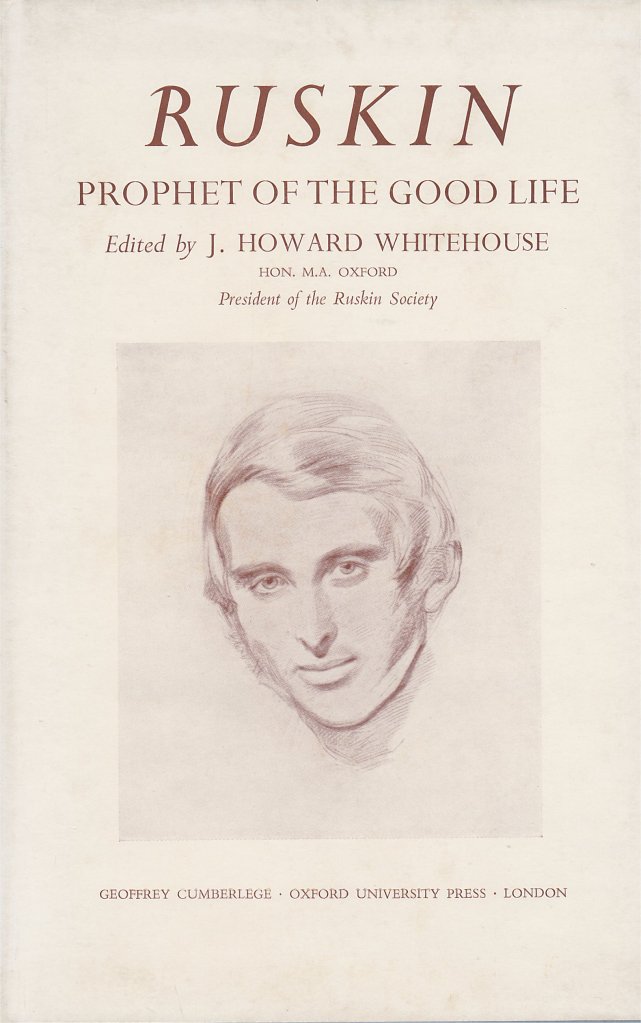
As many as half a dozen of the guests at the birthday dinners would give a short speech. All of these were transcribed for posterity. Many were collected and published in booklet form and distributed annually to the wider membership. Among the most notable are To the Memory of Ruskin (1934), Ruskin: Renascence (1946) and Ruskin: Prophet of the Good Life (1948).
Among the speakers at the first birthday dinner was the founder of the English-Speaking Union, Sir Evelyn Wrench, the editor of the Spectator and, like Whitehouse, a Companion (member) of Ruskin’s charitable society, the Guild of St George. The artist Sir William Rothenstein, the Liberal MP Isaac Foot, and the historian Dr G. P. Gooch were among other speakers.
Wrench and Rothenstein also served the Society as Vice-Presidents, and among others to do likewise were the educationist Michael Sadler, and the lawyer, physician, vegetarian and writer on health Dr Josiah Oldfield, both of whom had heard Ruskin lecture at Oxford when he was the Slade Professor of Fine Art. Others to serve the Society were the artist Albert Rutherston, the critic and art curator Kenneth Clark, the veteran war journalist Henry Nevinson, and the art critic, politician and mountaineer, Lord Conway of Allington.
Although the birthday dinners were suspended during the Second World War, the Society resumed its meetings in 1946. They continued until 1953 when, at the age of 80, Whitehouse was struck in the eye by a cricket ball at Bembridge and never recovered his health. He died two years later and the Ruskin Society folded.
THE RUSKIN SOCIETY OF LONDON
Bembridge School continued to be a centre of Ruskin enthusiasm after Whitehouse’s death. This was in large part thanks to Whitehouse’s Ruskin Collection which was diligently and expertly curated for 40 years by the late James Dearden, a former pupil at the school who became a distinguished Ruskin scholar, and a Director and Master of Ruskin’s Guild of St George. After organising an international conference in 1969 to mark the 150th anniversary of Ruskin’s birth, he founded and ran the Ruskin Association until it folded in the 1990s.
Another important force at Bembridge was Rhys Gerran Lloyd QC, Lord Lloyd of Kilgerran, who had briefly taught there, and had gone to be a prominent Liberal Party politician.
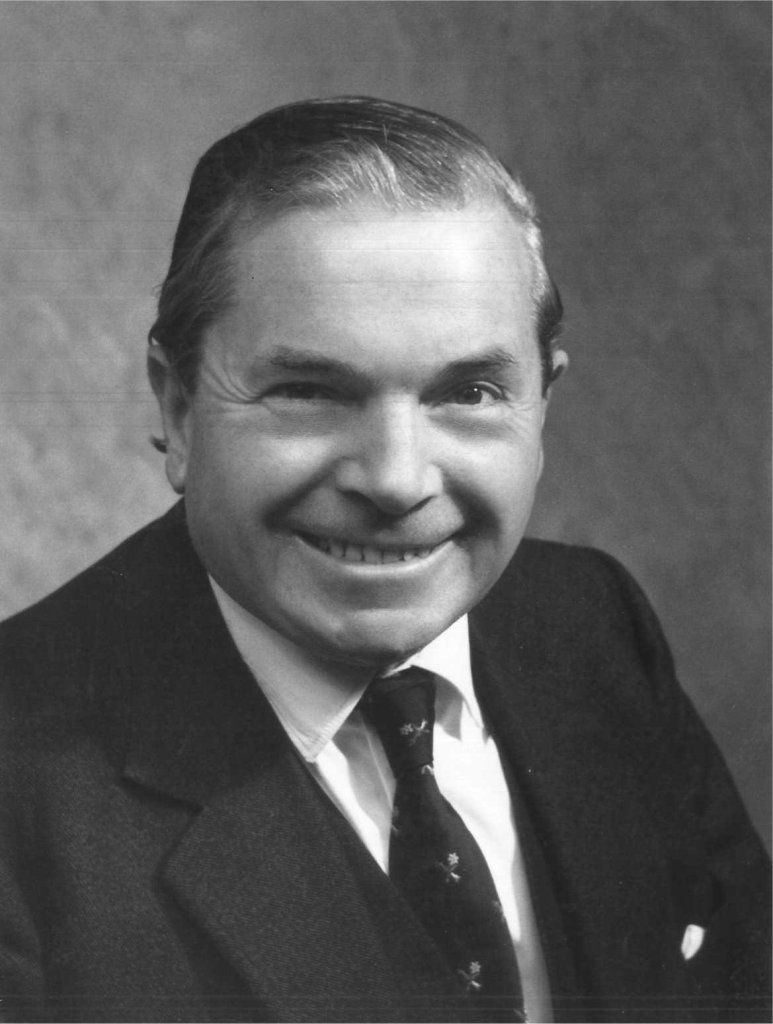
It was thanks to his efforts that the Ruskin Society of London was founded in 1985, following a meeting at the Royal institution. It continued into the 1990s and hosted a number of lectures on Ruskin.
THE RUSKIN SOCIETY TODAY
The present Ruskin Society was founded as a national organisation in 1997, with Sir Richard Body MP as chairman. Based in London, its focus is to celebrate the life, work and legacy of John Ruskin. For many years the Society met mainly in London clubs such as the Athenaeum. On Ruskin’s birthday, an illustrated lecture would be followed by a dinner and discussion. For some years, additional lectures were held around May and November, with an excursion organised for the summer Ruskin’s birthday continues to provide the focal point of the Society’s calendar of events, but the dinner has been replaced by light refreshments, and the Art Workers’ Guild has become the Society’s principal host.
In 2020, a new Ruskin Society of North America was founded with the intention of introducing Ruskin to new audiences around the world and providing a forum for those already familiar with his ideas. Visit its website at: https://www.ruskinsocietyna.org/
FURTHER READING
Atwood, Sara, ‘John Howard Whitehouse, John Ruskin and educational reform’: https://infed.org/mobi/john-howard-whitehouse-john-ruskin-and-educational-reform/
Dearden, James S., Ruskin, Bembridge and Brantwood: The Growth of the Whitehouse Collection (Ryburn, 1994)
Dearden, James S., ‘Whitehouse, (John) Howard (1873–1955)’, in Oxford Dictionary of National Biography, with portrait illustration http://dx.doi.org/10.1093/ref:odnb/52644
Eagles, Stuart, ‘The Ruskin Diaspora: A History of the Ruskin Society’ in idem, After Ruskin: The Social and Political Legacies of a Victorian Prophet, 1870-1920 (Oxford University Press, 2011), pp. 148-198
_, ‘The Wilderness Years: Ruskin’s Influence and the Ruskin Society, 1931-1955’, in The Friends of Ruskin’s Brantwood Newsletter (Spring 2009) pp. 9-14
_, ‘A Partial List of Lectures to the Ruskin Society, 1879-1912’
_, ‘A List of Articles in Saint George’: https://stuarteagles.co.uk/wp-content/uploads/2020/11/Saint-George.pdf
Wildman, Stephen, Keeper of the Flame: John Howard Whitehouse, 1873-1955 (Ruskin Library, 2005) (with contributions by Stuart Eagles and James S. Dearden).
USEFUL LINK
The text of the 1991 Ruskin Society of London lecture, ‘Ruskin and Mountain Landscape’ by Gordon Stainforth: http://www.gordonstainforth.co.uk/eyehill/pdfs/RuskinLecture1991.pdf
 ruskinsociety.uk